
MA Dissertation | Quantitative Analysis | The Gambia
School completion remains a significant challenge in global education policy, particularly in Sub-Saharan Africa, where access to education does not always translate into successful completion. In my MA dissertation, I examine how socio-economic factors such as wealth, gender, region, and location influence school completion in The Gambia, utilising Amartya Sen’s Capability Approach as a framework for analysis.
Using data from the 2019–2020 Demographic and Health Survey (DHS), I employ logistic regression to analyse disparities across primary, lower secondary, and upper secondary school levels. The findings reveal significant inequalities: children from wealthier and urban households are more likely to complete school, while those in poorer and rural contexts face disadvantages.
The research highlights how structural inequalities can shape educational opportunities beyond access alone and considers policy responses including targeted cash transfer programmes, rural infrastructure development, and gender-sensitive education policies.
RESEARCH AT A GLANCE
Research Question:
The Overarching Research Question:
How do socio-economic factors influence school completion in The Gambia?
Sub-research Questions:
- How does wealth predict completion rates at primary, lower, and upper secondary schools in The Gambia?
- In addition, how do sex, region, and location predict completion rates at primary, lower, and upper secondary schools in The Gambia?
Methodology
Quantitative analysis | Logistic regression
Data
2019-2020 Demographic and Health Survey (DHS)
Framework
Amartya Sen’s Capability Approach
KEY FINDINGS
The analysis identified substantial differences in school completion associated with household wealth, geographical location, gender and region.
- The Wealth Gap Widens at Higher Levels of Education
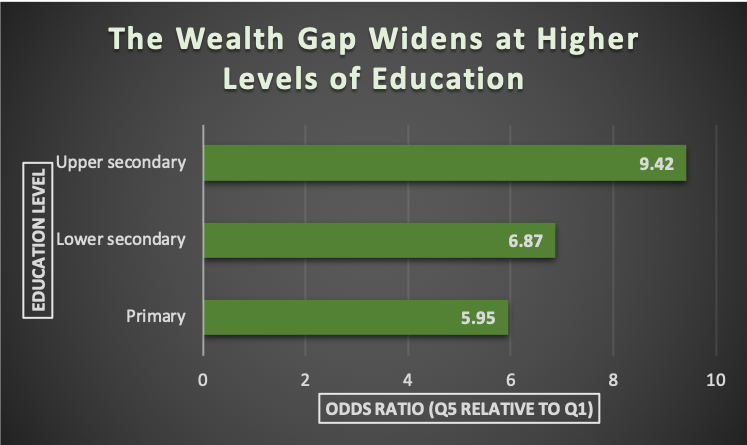
Note: Q1 (the poorest wealth quintile) is the reference group. Values show the odds of school completion for Q5 (the wealthiest quintile) relative to Q1.
Source: Author’s analysis of GDHS 2019-20 data; simple logistic regression, Table 4.
The results show a strong association between household wealth and school completion, with the wealth gap becoming larger at higher levels of education. Compared with children in the poorest wealth quintile (Q1), those in the wealthiest quintile (Q5) had nearly six times the odds of completing primary education, rising to over nine times the odds for upper-secondary completion.
Policy implication
Reducing financial barriers to education is particularly important for progression into and completion of secondary education. Policies such as targeted cash transfers and other forms of social protection may help reduce the economic constraints that disproportionately affect children from poorer households.
2. School Completion Probability Increases with Household Wealth
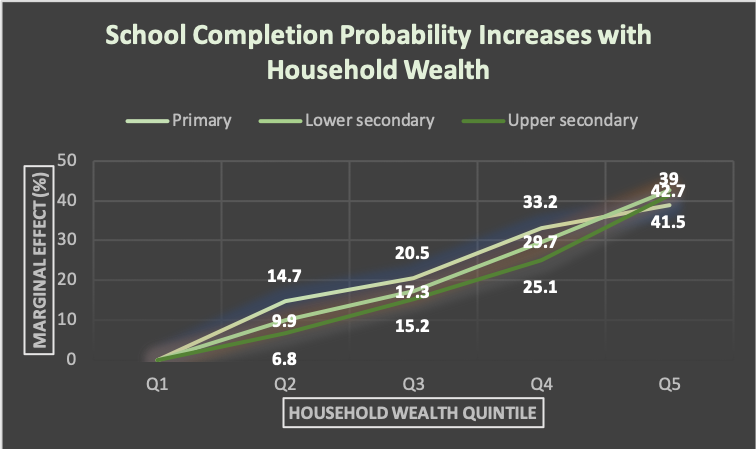
Note: Q1 is the reference wealth quintile. Values represent percentage-point differences in the predicted probability of school completion relative to Q1.
Source: Author’s analysis of GDHS 2019-20 data; marginal effects from a simple logistic regression, Table 8.
The marginal effects demonstrate a clear wealth gradient in school completion. Relative to the poorest quintile, children from wealthier households had substantially higher predicted probabilities of completing each level of education. The difference is particularly pronounced among the wealthiest households, reaching +39.0 percentage points for primary, +42.7 percentage points for lower secondary, and +41.5 percentage points for upper secondary completion.
Policy implication
Improving access alone may not be sufficient to close educational inequalities. Policies should address the socio-economic barriers faced by poorer households, particularly as children progress through the education system.
3. Wealth and Location Both Shape Upper Secondary School Completion
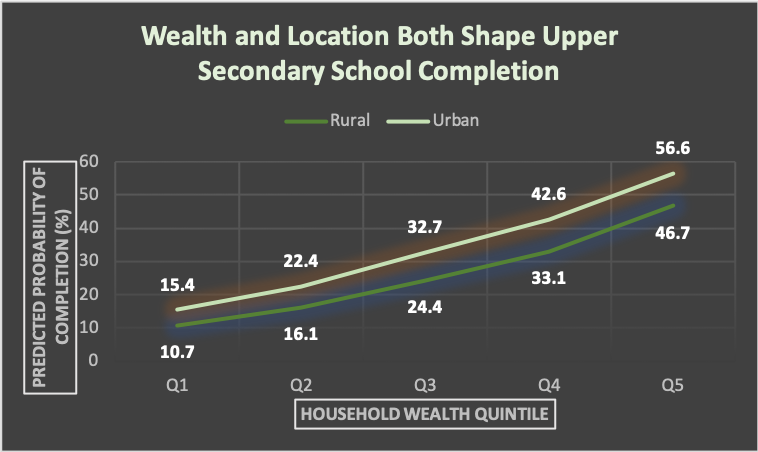
Note: Predicted probabilities are estimated from the interaction between household wealth and location. Urban and rural categories are shown across each wealth quintile.
Source: Author’s analysis of GDHS 2019-20 data; wealth x location interaction model, Table 20.
The interaction between wealth and location highlights two overlapping inequalities in upper-secondary completion. Predicted completion probabilities increase with household wealth in both rural and urban areas, while urban children consistently have higher predicted probabilities than their rural counterparts. The gap therefore cannot be explained by household wealth alone; where a child lives also matters.
Policy implication
Equity-focused education policy should combine household-level support with investment in underserved rural areas. Improving rural infrastructure and access to quality education, alongside measures that reduce household-level financial barriers, can help address the multiple disadvantages affecting school completion.
CONCLUDING THOUGHTS
Taken together, these findings illustrate that educational inequality in The Gambia is multidimensional. Household wealth is strongly associated with school completion, while location further shapes educational opportunity. Addressing these inequalities therefore requires policies that combine financial support for disadvantaged households with sustained investment in underserved communities.
FEATURED PUBLICATION
Featured in Global Research Insights
My MA research on socio-economic barriers to school completion in The Gambia has been selected for inclusion in Global Research Insights: Voices from across the Globe, published by the Centre for International Education at the University of Sussex.
The chapter draws on my MA dissertation to examine how household wealth, gender, region, and location shape educational opportunity and school completion, using Amartya Sen’s Capability Approach and quantitative analysis of the 2019-2020 Gambia DHS.
Full citation:
Szekrenyes, D.(2025) From Inequality to Opportunity: Understanding Socio-Economic Barriers to School Completion in The Gambia through the Capability Approach. In N. Udosen and M. Dunne (eds) Global Research Insights: Voices from across the Globe. Centre for International Education, University of Sussex, UK. Chapter 8.